

For operators of critical infrastructure
NIS2 requires you to know who has access to your sensitive areas.
The NIS2 directive and the German KRITIS Act make protecting critical infrastructure binding — physically too. Operators must be able to trace at any time who has access to sensitive zones; visitor management is explicitly part of it. Breaches carry heavy fines and personal liability for management. visitvia proves exactly this building block.
NIS2 · KRITIS Act
What's required for physical protection
NIS2 requires risk-management measures that also cover physical security; the KRITIS Act makes the protection of sensitive areas binding. At reception and at the zone they meet.
Access to sensitive zones
Physical protection
Server rooms, control rooms, sensitive areas: whoever gets in must be controlled and recorded — not by gut feeling.
Traceable who was there
Evidence
Operators must be able to prove at any time who had access. A log that can't be changed is the basis for that.
Visitor management
Explicitly named
Register, bind and document visitors and externals in an orderly way — as part of the physical security measures.
Fines and liability
On breach
Around 29,500 companies are affected by the NIS2 implementation act. Breaches carry heavy fines — and management is personally liable.
This overview is guidance, not an audit result: whether and how you are affected is decided by your legal and security officers. visitvia supplies the evidence for one building block.
You can provide this evidence starting tomorrow.
Your own workspace is ready in minutes — no payment details, no paid contract.
What visitvia proves for it
From the question of who had access to solid evidence
What no one can answer completely today, the app records — traceable and immutable.
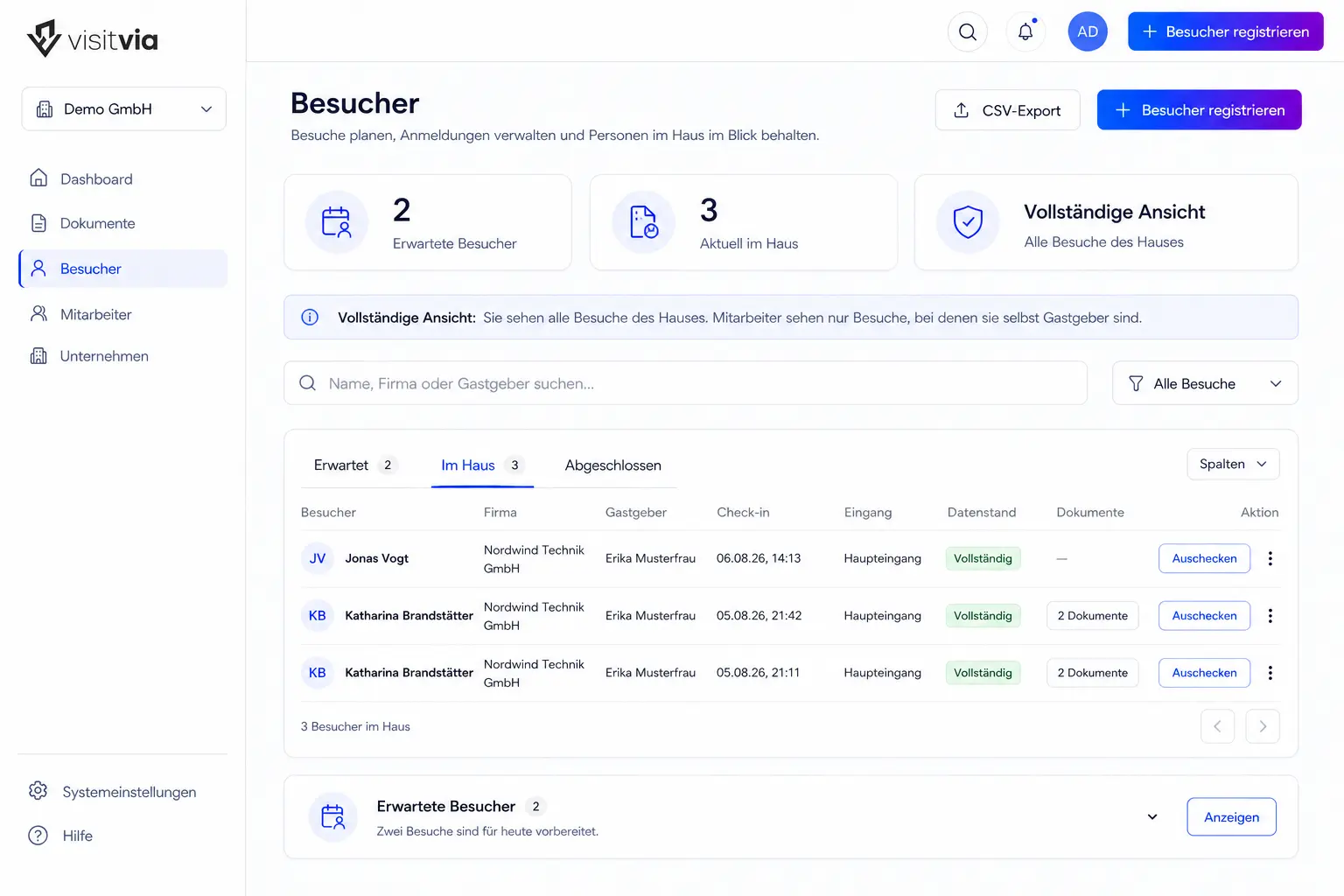
Visitors and externals check in at the terminal; anyone not registered shows up as exactly that in the list.
The confidentiality agreement and the safety briefing are signed — a signed PDF, in the version that applied.
The log shows who was there, when and with which host — searchable by date and time, with arrival and check-out.
No one can change it afterwards: every entry is firmly chained to the previous one — exactly the traceability that's required.
Your data is held in a data centre in the EU (France), in a dedicated database per customer — with no transfer to a third country.
FAQ
What information-security and critical-infrastructure officers ask first
Does visitvia make us NIS2-compliant?
No — NIS2 is far more than reception: the whole risk management, reporting channels, technical safeguards. visitvia covers one building block: the documented, traceable access of visitors and externals to your areas. The documents for it are available on request.
Does visitvia replace access control to our server rooms?
No. The electronic access control and alerting at the sensitive zones stay yours. visitvia is the check-in, the obligation and the log at reception — it provides evidence of who checked in and what they signed, not the door technology.
How visitvia establishes tamper-proofing, tenant separation and retention periods in technical terms is on the Security page — written for your information-security and data-protection officers.
Show it to your information-security officer before the regulator asks.
Traceable access, obligation and log to click through — free, no credit-card details.