

For automotive suppliers
Your OEM requires TISAX®. At reception, the evidence still runs on paper.
As a supplier, your customers send you into the assessment — and there it's rarely about your policy, but about a single visit on a particular day: was it registered, did they sign the confidentiality agreement, is it on record? visitvia covers exactly this slice.
TISAX® · VDA ISA
Four things that meet at reception in the assessment
TISAX® assesses along the VDA ISA catalogue. The points that concern reception are almost everywhere the same — and there it's the last process still running on paper.
Controlled access
Physical security
Visits registered, externals escorted, every entry on record. Reception is where it's decided whether this runs in an orderly way or by gut feeling.
Externals bound to confidentiality
HR security · Supplier relationships
Anyone given access to information worth protecting is first bound to confidentiality in writing — provable, not by a handshake.
Prototype protection
VDA ISA, chapter 8
Prototypes have their own visitor rules: a camera ban down to the smartwatch, escort in the zones, and a documented briefing at project start and at least once a year.
Evidence for a single visit
In the assessment
What's asked for is rarely the policy, but proof of a particular visit on a particular day. A binder is not a good answer then.
This overview is guidance, not an audit result: what counts in your assessment is decided by your assessor. visitvia supplies the evidence — judging it is your assessor's job.
You can provide this evidence starting tomorrow.
Your own workspace is ready in minutes — no payment details, no paid contract.
What visitvia proves for it
From a rough guess to evidence you can present
What you do at reception today, the app does tomorrow — and records it as it goes, in a form that holds up in the assessment.
The confidentiality agreement is signed with a finger and becomes a signed PDF — tied firmly to the document version that applied at the time. Change the document, and old signatures stay with their version.
The camera ban and visitor rules are shown in the welcome text at the terminal. No confirmation, no completed check-in — and the log records which version applied.
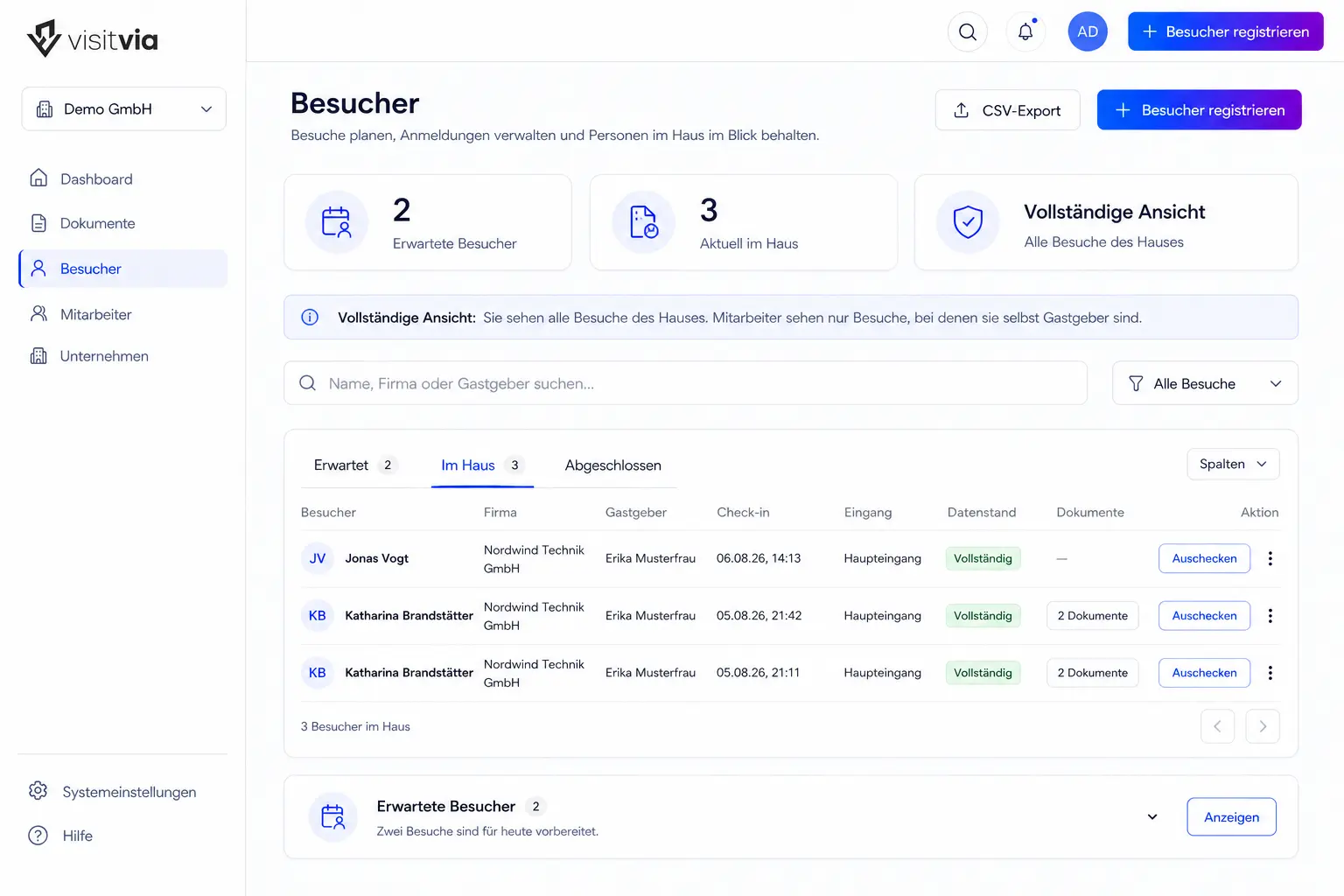
The visitor log shows who was there, when and with which host — searchable by date and time, with arrival and check-out.
No one can change it afterwards: every entry is firmly chained to the previous one. Not your administrators, and not us.
If the assessor asks about a visit from months ago, you filter to the day, open the visit, show the signed confidentiality agreement and export the log — faster than the question was asked.
FAQ
What suppliers ask first
Is visitvia TISAX-certified?
No — there is no TISAX seal for a piece of software. TISAX® assesses sites and organisations against the VDA ISA catalogue, not individual tools.
You are assessed; visitvia makes sure you have something to present at reception. The documents for your assessment — how tamper-proofing is established, how tenant separation works — are available on request.
Does visitvia cover the whole of prototype protection?
Only the reception and evidence part: the written confidentiality agreement, the documented visitor rules with a camera ban, and the log of who was there when. The physical side — electronic access control, alarms, visual screening at the prototypes — stays yours. visitvia doesn't replace door technology; it provides evidence of what happens at reception.
How visitvia establishes tamper-proofing, tenant separation and retention periods in technical terms is on the Security page — written for your information-security and data-protection officers.
Show it to your information-security officer before the next assessment.
Log, retention periods and confidentiality agreement to click through — free, no credit-card details.